
Blog / November 13, 2026
How to Rank in ChatGPT: 9 Steps to Get Your Business Recommended

By Chaitanya Khanna, SEO Technician · Reviewed by Vadim Kirichenko
Published November 13, 2026
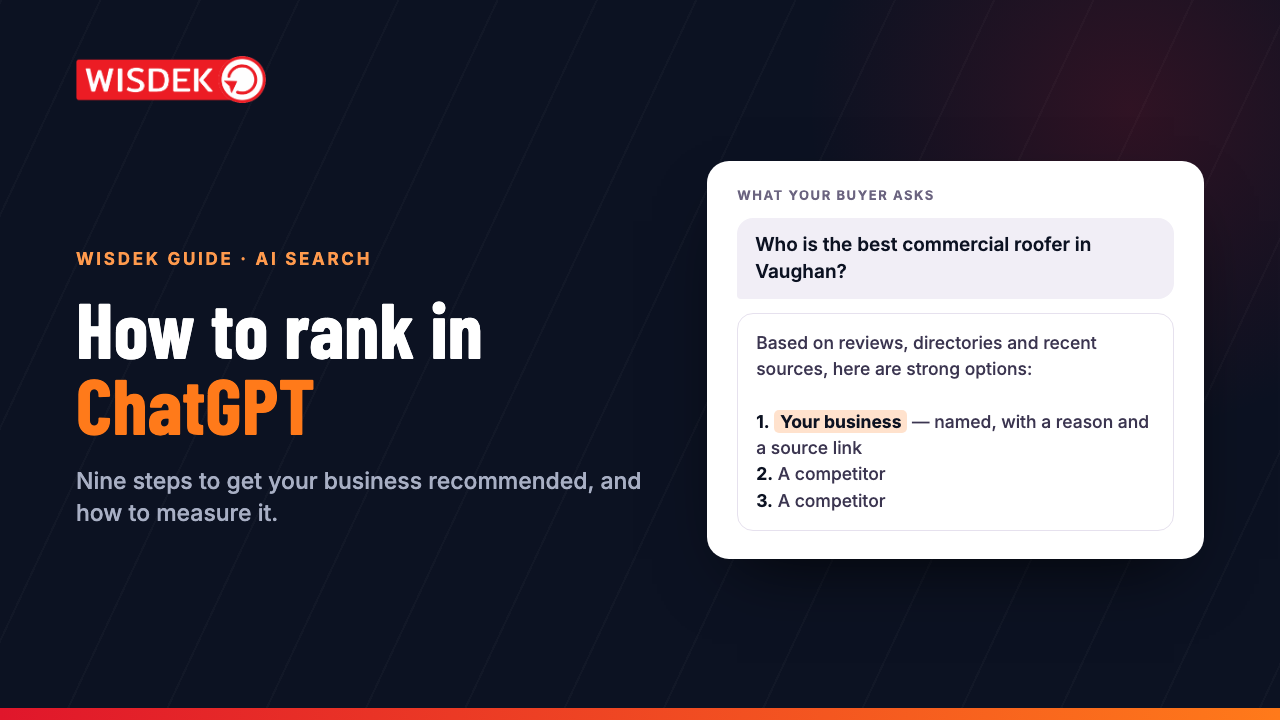
Short answer: You can't buy or submit your way into a ChatGPT recommendation. ChatGPT names the businesses it can read, verify and find mentioned elsewhere. Let its search crawler in, keep your business facts identical everywhere, publish pages that answer buyer questions directly, and earn reviews and mentions on sites it already trusts.
ChatGPT passed 900 million weekly users in February 2026. People now ask it the question that used to go to Google: who should I hire? The answer is not ten blue links. It is two or three names, a sentence about each, and a few source links.
If your business is one of those names, you get the call. If it isn't, you never learn the question was asked. This guide explains how ChatGPT picks those names today and what you can do about it.
How do I get my business recommended by ChatGPT?
You make your business easy for ChatGPT to read, easy to verify, and hard to leave out. In practice that is nine jobs, in this order:
- Ask it first. Write down the 10 to 20 questions a buyer would ask, such as "best commercial roofer in Vaughan", and run them in ChatGPT with search turned on. Note who gets named and which sources are cited.
- Let the crawler in. Check that your robots.txt file and your firewall allow OAI-SearchBot, the crawler behind ChatGPT search.
- Make the site readable without JavaScript. Your services, prices, service areas and contact details should be in the page's HTML, not loaded afterwards.
- Fix your facts. Use one business name, one address, one phone number and one founding year everywhere: your website, Google Business Profile, Bing Places, directories and social profiles.
- Answer the question in the first two sentences. Each service page should open with who you serve, where, what it costs and why you are a safe choice.
- Add structured data. Mark up your business, services and FAQs with schema so machines don't have to guess.
- Get into Bing. Set up Bing Webmaster Tools, submit your sitemap and switch on IndexNow.
- Earn third-party proof. Reviews, industry directories, local news, trade associations and "best of" lists are where ChatGPT looks for confirmation.
- Measure monthly. Run the same questions every month and track how often you are named.
The rest of this article explains why each step matters. To see where you stand first, our free growth plan includes an AI visibility check.
How does ChatGPT decide which businesses to name?
ChatGPT answers from two places: what the model learned in training, and what it finds on the live web when it searches.
Training data. The model learned from a very large snapshot of the web. If your business was written about often and consistently before that snapshot, it may be named from memory. This is slow to change and impossible to edit directly.
Live search. For "who should I hire" questions, ChatGPT often searches. OpenAI's help page on ChatGPT search says it searches automatically when a question would benefit from current information, rewrites your question into one or more targeted queries, and sends them to search providers. The same page points readers to Microsoft's privacy statement for one of those providers. Microsoft runs Bing. ChatGPT also uses its own crawler, OAI-SearchBot, to surface websites in search answers, and it uses your approximate location for local questions.
Then it reads several of the pages it found and writes one answer. There is no "position one". A business gets named when multiple sources agree it is a good fit for the question. That is why ChatGPT SEO is less about one page ranking and more about the whole web telling the same story about you.
| What ChatGPT looks at | What to do | How long it takes |
|---|---|---|
| Whether its crawler can reach your pages | Allow OAI-SearchBot in robots.txt and at your firewall or CDN | About a day after the change |
| Whether the page text is in the HTML | Server-render services, prices, areas and FAQs | Days to weeks, depending on your site |
| Whether your business facts agree everywhere | One name, address, phone and founding year across every profile | 2 to 6 weeks to clean up |
| Whether a page answers the question directly | Answer-first service pages, FAQs, real numbers, named sources | 2 to 8 weeks to publish and be picked up |
| Whether Bing knows your site | Bing Webmaster Tools, sitemap, IndexNow | Days |
| Whether other sites vouch for you | Reviews, directories, trade listings, local press, "best of" lists | 3 to 6 months, then ongoing |
The time ranges are planning estimates, not promises. Competitive markets take longer.
Can ChatGPT actually read your website?
Often it can't, and the owner has no idea. Two things block it: crawler rules and JavaScript.
OpenAI's crawler documentation lists three main user agents, and each does a different job:
- OAI-SearchBot surfaces websites in ChatGPT's search answers. OpenAI says sites that opt out of it will not be shown in search answers, and it recommends allowing it in robots.txt.
- GPTBot collects content that may be used to train future models. You can allow search and still block training. The settings are independent.
- ChatGPT-User fetches a page when a person asks ChatGPT to look at it. It is not used to decide what appears in search.
OpenAI notes that a robots.txt change takes about 24 hours to reach its search systems. Also check your security plugin or CDN. Some block AI bots unless you change the setting.
The second problem is JavaScript. A Vercel and MERJ analysis published in December 2024 found that none of the major AI crawlers it tracked rendered JavaScript, including OAI-SearchBot, GPTBot and ChatGPT-User. If your prices, service list or reviews only appear after scripts run, ChatGPT may see an almost empty page. View your page source. If the words aren't there, fix that first.
Why do other websites matter more than your own?
Because anyone can call themselves the best. For a recommendation, ChatGPT looks for agreement from sources you don't control.
Run a "best X in Y" question and open the Sources panel. You will usually see directories, review platforms, industry associations, local news and list articles, with a few business websites mixed in. Those are the pages you need to be on:
- Reviews. Recent, detailed reviews on Google and on the platforms that matter in your trade. Reviews that mention the service and the city are especially useful, because they match how people ask.
- Directories and associations. The ones a buyer in your industry would actually check, with complete profiles.
- "Best of" lists. If an article ranking businesses like yours is being cited, ask the publisher how to be considered, and give them proof.
- Press and community mentions. A local news story or a supplier's case study is a mention ChatGPT can verify.
Consistency matters as much as volume. If your website says founded in 1998, one directory says 1995 and another shows an old phone number, ChatGPT has three versions of you and less reason to trust any of them. It is the same discipline as good local SEO, applied more strictly.
What kind of page gets quoted?
A page that answers the question plainly, backs it with specifics, and is easy to lift a sentence from.
The best public evidence is the Princeton-led study that coined generative engine optimization. Across a benchmark of 10,000 queries, the researchers found that adding citations, quotations from relevant sources and statistics raised a page's visibility in AI answers by up to 40%. Keyword stuffing did not perform well. Our guide to what generative engine optimization is covers the study in more detail.
For a business website, that means:
- Open each service page with a two-sentence answer: what you do, for whom, where, and from what price.
- Use headings that match real questions, then answer in the first line under each one.
- Give real numbers: price ranges, timelines, years in business, jobs completed. Vague pages don't get quoted.
- Name your sources when you cite a fact, and show who wrote and reviewed the page. Ours are covered in our editorial policy.
- Add schema for your business, services and FAQs.
- Keep pages current. An answer that needs this year's information favours pages updated this year.
Does Bing matter for ChatGPT?
Yes. Many businesses have never looked at Bing, and it is one of the quickest fixes on this list.
Because ChatGPT search sends queries to search providers, a page that is missing from those indexes is harder to find. Set up Bing Webmaster Tools, submit your sitemap, and claim your Bing Places listing with the same details as your Google Business Profile. Then turn on IndexNow, an open protocol that tells participating search engines the moment a page is published or changed. The technical foundation is the same work as regular SEO, so plan the two together.
Is an llms.txt file worth adding?
It is cheap to add and worth having, but don't expect it to move rankings. The llms.txt proposal is a plain-text summary of your site written for AI systems. Ours is at /llms.txt.
In June 2025, Google's John Mueller said that no AI system was using llms.txt, and OpenAI's crawler documentation does not list it as something that affects ChatGPT search. We treat it as a single source of truth about a business, not as a ranking signal. The steps above matter far more.
How do you measure whether it's working?
You measure it with a fixed list of questions, run on a schedule, and with the leads that follow.
- A prompt panel. Keep the same 20 to 30 buyer questions. Run them monthly in ChatGPT with search on, in a fresh chat, and record whether you are named, in what position, which page is cited and which competitors appear.
- Share of voice. Out of all the answers, how many name you? That one number, tracked monthly against two or three competitors, shows the trend.
- AI referrals. In Google Analytics 4, filter traffic by source for chatgpt.com and the other AI tools. Then check which of those visits became calls or form fills.
- Ask your customers. Add "ChatGPT or another AI tool" to your "how did you hear about us" question.
Answers vary between runs and between users, so one screenshot proves little. Look at the pattern over months. This tracking is part of our AI SEO service.
Can you pay to appear in ChatGPT?
You can pay for an ad, but not for a recommendation. OpenAI began testing ads in ChatGPT in the United States on February 9, 2026. They appear below an answer, are clearly labelled, and are shown to Free and Go plan users. OpenAI states that ads do not influence the answers ChatGPT gives. Canada is now on OpenAI's list of countries with self-service Ads Manager access.
So there are two separate jobs: earning the mention, and buying the sponsored placement under it. We explain the paid side on our ChatGPT ads page.
How long does it take, and what can't anyone promise?
Expect first signs in 30 to 90 days and meaningful movement in four to six months. Technical fixes show up fastest. Reviews, mentions and list placements take longest and count most.
Nobody controls what ChatGPT says. OpenAI's own help page warns that search results and citations can be incomplete, outdated or incorrect. Anyone who guarantees you a recommendation is guessing. What a good agency can promise is the work, the tracking and an honest monthly report. Google says much the same about its own AI results: its guidance for site owners says there are no special optimizations required beyond sound SEO.
For budgeting, see our breakdown of what SEO costs in Canada. To find out where your business stands in ChatGPT today, ask for a free growth plan. We'll run your buyer questions, show you who is being named, and tell you plainly whether this is worth your money yet.
Frequently asked questions
How do I get ChatGPT to recommend my business?
Make your business easy to read and easy to verify. Allow OpenAI's search crawler, OAI-SearchBot, on your website. Keep your name, address, phone number and founding year identical everywhere. Publish pages that answer buyer questions in the first two sentences. Then earn reviews, directory listings and mentions on the third-party sites ChatGPT cites for your industry and city.
Can I pay ChatGPT to recommend my business?
No. You can buy ads in ChatGPT, which appear below an answer and are clearly labelled, but OpenAI states that ads do not influence the answers ChatGPT gives. A recommendation inside the answer has to be earned through readable pages, consistent business facts and third-party proof. Ads and organic mentions are two separate jobs.
Why does ChatGPT recommend my competitor instead of me?
Usually because your competitor is easier to verify. They may have more recent reviews, appear in the directories and list articles ChatGPT cites, or have pages that answer the question directly. Run the question with search on, open the sources, and compare. The gap is normally visible within a few minutes.
Does ChatGPT use Google or Bing to find businesses?
OpenAI says ChatGPT search uses its own crawler, OAI-SearchBot, and sometimes partners with other search providers. Its help page points to Microsoft's privacy statement for one of them, and Microsoft runs Bing. In practice, being indexed in Bing and reachable by OAI-SearchBot both matter. Set up Bing Webmaster Tools even if you have never used Bing.
How long does it take to show up in ChatGPT answers?
Technical fixes can take effect quickly. OpenAI says a robots.txt change reaches its search systems in about 24 hours. Being named in answers takes longer. Expect first signs in 30 to 90 days and meaningful movement in four to six months, depending on your market and how much third-party proof you need to build.
Do I need an llms.txt file to rank in ChatGPT?
No. An llms.txt file is cheap to add and gives AI systems one clean summary of your business, so we recommend having one. But OpenAI's crawler documentation does not list it as a factor in ChatGPT search, and Google's John Mueller said in 2025 that no AI system was using it. Crawler access, clear pages and third-party mentions matter far more.
Is ranking in ChatGPT different from regular SEO?
The foundation is the same: a fast, crawlable website, clear pages and a good reputation. The differences are that ChatGPT gives two or three names instead of ten links, relies heavily on what other websites say about you, and may not read content that depends on JavaScript. It rewards direct answers and consistent facts more than keyword targeting.
Can anyone guarantee a ChatGPT recommendation?
No. Nobody outside OpenAI controls what ChatGPT says, answers vary between users and over time, and OpenAI itself notes that search results can be incomplete or incorrect. An honest agency guarantees the work and the tracking, shows you each month where you are named, and tells you when the effort is not yet worth your money.
Sources
- OpenAI: Overview of OpenAI Crawlers (OAI-SearchBot, GPTBot, ChatGPT-User)
- OpenAI Help Center: Searching the web with ChatGPT
- TechCrunch: ChatGPT reaches 900M weekly active users (February 27, 2026)
- Aggarwal et al.: GEO: Generative Engine Optimization (arXiv 2311.09735, KDD 2024)
- Vercel and MERJ: The rise of the AI crawler (December 17, 2024)
- Search Engine Roundtable: Google: No AI System Currently Uses LLMs.txt (June 18, 2025)
- llmstxt.org: The /llms.txt file proposal
- OpenAI Help Center: Ads in ChatGPT
- OpenAI Help Center: Ads Manager Availability
- Bing Webmaster Tools
- IndexNow
- Google Search Central: AI features and your website
Guides worth reading next
Rather have it done for you?
Tell us about your business. Within 2 business days you get an honest plan: the channels we'd use, what it costs, and the lead numbers we'd stand behind — in writing.
- An honest look at where your customers come from today
- The channels we'd use, and why
- What it will cost
- How many new leads to expect, and by when
- A straight answer if we're not the right fit
Where you stand today
The plan, channel by channel
The numbers we stand behind
Free, and yours to keep whether you hire us or not.
Prefer to talk? Call 416-514-1672