
Blog / November 13, 2026
What Is Generative Engine Optimization (GEO)? A Plain-English Guide for Business Owners

By Chaitanya Khanna, SEO Technician · Reviewed by Vadim Kirichenko
Published November 13, 2026
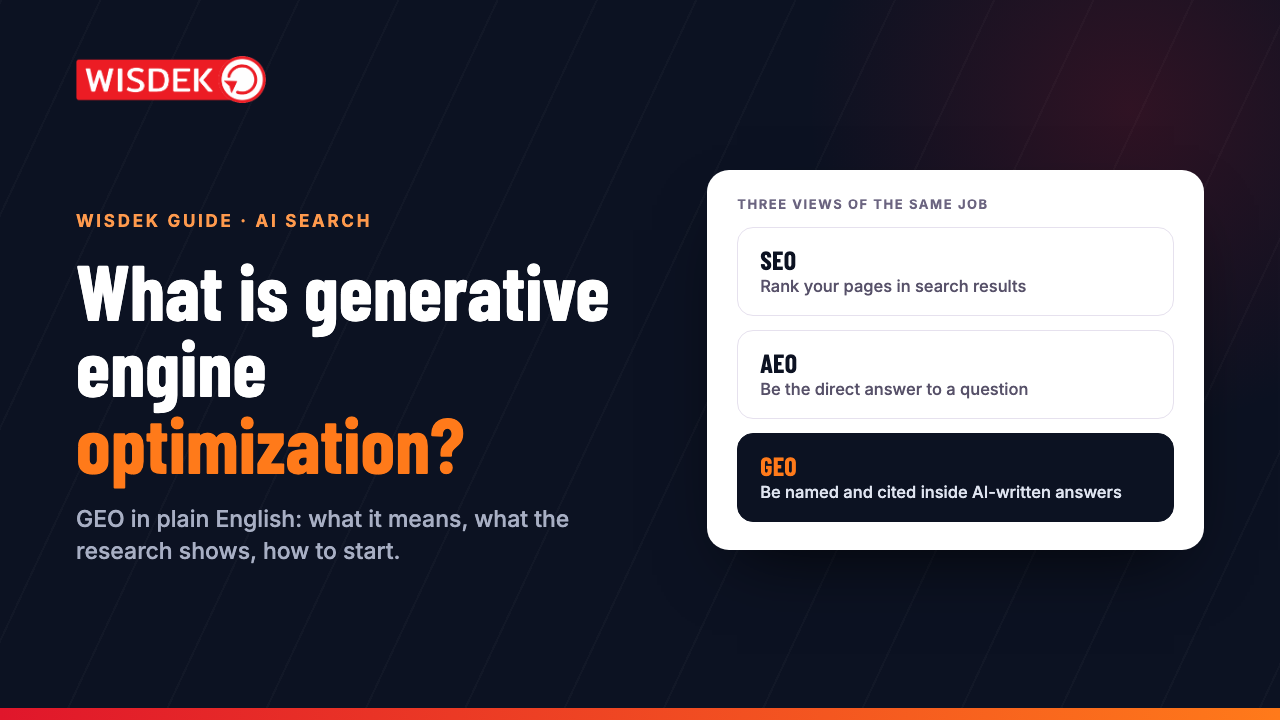
Definition: Generative engine optimization (GEO) is the practice of making a business, its website and its wider web presence easy for AI answer engines such as ChatGPT, Google AI Overviews, Perplexity, Gemini and Copilot to find, understand, trust and cite, so the business is named when a buyer asks AI a question.
Your buyers used to type a search and scan ten blue links. Now many of them ask a question and read one answer. That answer names two or three businesses. GEO is the work of being one of them. This guide explains what it means, what the evidence says works, and how to start.
What is generative engine optimization, in plain English?
Generative engine optimization is the work of getting your business named, described accurately and cited inside an AI-written answer, instead of only ranking a page in a list of links.
A “generative engine” is any search tool that writes its answer rather than only listing pages. ChatGPT, Google’s AI Overviews and AI Mode, Perplexity, Gemini, Microsoft Copilot and Claude all work this way. They read sources, summarize them and, most of the time, link to a few of them.
It matters because people click less when an AI answer appears. Pew Research Center analyzed 68,879 real Google searches from March 2025. Users clicked a regular result on 8% of visits when an AI summary appeared, against 15% when it did not. Only 1% of those visits included a click on a link inside the summary itself. If the answer is where the decision happens, you want to be in the answer.
Where does the term “GEO” come from?
The term comes from a research paper, not a marketing department. “GEO: Generative Engine Optimization” was first posted in November 2023 by researchers at Princeton University and IIT Delhi, working with independent collaborators, and was accepted to the KDD 2024 conference.
The team built a benchmark of 10,000 queries and tested nine ways of rewriting a web page to see which ones made a generative engine use it more. Three findings are worth knowing:
- Evidence beats adjectives. Citing credible sources, adding quotations and adding statistics were the top three methods. Each lifted a page’s visibility in the answer by roughly 30–40% on the paper’s main measure.
- Keyword stuffing did not help. Repeating the query’s keywords, the classic SEO shortcut, performed poorly. In the paper’s test on Perplexity it did about 10% worse than doing nothing.
- Smaller sites gained the most. For pages ranked fifth in regular search, citing sources raised visibility by 115%. The top-ranked page lost ground on average.
This was a controlled study on the engines of its day. Treat it as direction, not a promise. No tactic guarantees a place in any AI answer.
How do generative engines build an answer?
Most AI answers are built in three steps: retrieve, synthesize, cite.
- Retrieve. The engine turns the question into one or more searches and pulls candidate pages. Google says AI Overviews and AI Mode may use “query fan-out”, running several related searches across subtopics to gather sources.
- Synthesize. A language model reads those passages and writes one answer. It lifts short, clear, self-contained statements far more easily than it untangles a wall of text.
- Cite. The engine links the sources it leaned on. Those links, and the names in the answer, are the new rankings.
Two practical consequences follow. First, you cannot be cited if you cannot be retrieved. OpenAI states that sites opted out of its OAI-SearchBot crawler will not be shown in ChatGPT search answers, and Google says a page must be indexed and eligible for a snippet to appear as a supporting link. Second, a 2024 Vercel study found that none of the major AI crawlers it tracked, including OpenAI’s, Anthropic’s and Perplexity’s, rendered JavaScript. If your content only appears after scripts run, those crawlers may never see it.
GEO vs SEO vs AEO: what is the difference?
They are three views of the same job: being found when someone looks for what you sell. The difference is where you appear and how success is counted.
| SEO | AEO | GEO | |
|---|---|---|---|
| Stands for | Search engine optimization | Answer engine optimization | Generative engine optimization |
| Goal | Rank your pages high in search results | Be the direct answer to a specific question | Be named and cited inside AI-written answers |
| Where you appear | Google and Bing results, the map pack | Featured snippets, “People also ask”, voice assistants | ChatGPT, Google AI Overviews and AI Mode, Perplexity, Gemini, Copilot, Claude |
| What is optimized | Pages, keywords, links, site speed | Question-and-answer content, structured data | Citable facts, entity consistency, third-party mentions, crawler access |
| How success is measured | Rankings, organic clicks, leads | Snippets and answer boxes won | Share of answers, cited URLs, AI-referred leads |
You will also hear “AI SEO”, “LLM SEO” and “AI search optimization”. They are umbrella names for the same work. We call our own service AI SEO because that is what owners search for.
Whatever the label, GEO sits on top of SEO. It does not replace it. Google’s own guidance says there are no additional requirements to appear in AI Overviews or AI Mode beyond sound SEO. That is why a solid SEO foundation and, for local businesses, local SEO still come first.
What actually moves visibility in AI answers?
The things that move visibility are the things that make you easy to quote and easy to trust.
- Clear, citable statements. Put the answer in the first sentence under each heading. Microsoft’s guidance for Bing and Copilot recommends question-style headings, Q&A pairs, lists and tables, and sentences that still make sense when lifted out of context.
- Statistics with sources. Numbers with a named source were among the strongest methods in the GEO study. Unsourced numbers are a liability.
- Quotations and first-hand detail. A real quote, a real price, a real timeline.
- Third-party mentions. Engines check what others say about you: news sites, industry publications, directories, reviews and forums. A business that only talks about itself is a weak source.
- Entity consistency. One name, one address, one phone number, one founding year, everywhere. Conflicting facts make an engine less sure which business you are.
- Structured data. Schema markup labels your business, services and FAQs so machines read them with confidence. It has to match the visible text.
- Crawler access. Allow the search crawlers you want to be found by, such as OAI-SearchBot, PerplexityBot and Claude-SearchBot, and serve your key content as plain HTML.
- Freshness. Keep key pages dated and current. A page that looks abandoned is a risky thing to quote.
What does not work?
Shortcuts do not work, and some of them are sold hard.
- Keyword stuffing. It failed in the research, and it reads badly to people.
- Treating llms.txt as a magic switch. The llms.txt proposal is a simple text file that gives AI tools a clean summary of your site. It is cheap, and we publish our own. But no major engine has confirmed it as a ranking signal, and Google says you do not need new machine-readable or AI text files to appear in its AI features. Publish one. Do not pay much for it.
- Hiding your answers. Microsoft warns that content inside tabs, expandable menus, images or PDFs can be skipped.
- Guarantees. Nobody controls what an AI says. Microsoft puts it plainly: there is “no secret sauce that guarantees selection in AI answers”.
Which generative engines matter?
Six matter for most Canadian businesses today, and they do not all read the web the same way.
- ChatGPT (OpenAI). Searches the web with its own crawler, OAI-SearchBot, and links sources in its search answers.
- Google AI Overviews and AI Mode. Built on Google’s own index. If Google has not indexed a page, it is not eligible.
- Gemini (Google’s assistant). Vercel’s study found it uses Googlebot’s infrastructure, so it can read JavaScript-rendered pages.
- Perplexity. An answer engine that shows its sources beside each answer. Its PerplexityBot crawler exists to surface and link websites in those results.
- Microsoft Copilot. Built into Windows, Edge and Microsoft 365. Microsoft reports Copilot citations inside Bing Webmaster Tools, so being indexed in Bing is the way in.
- Claude (Anthropic). Uses its own search and user-request crawlers when it looks things up.
You do not need six strategies. One clean, well-sourced, crawlable site and a consistent reputation serve all of them. For ChatGPT specifically, see our step-by-step guide on how to rank in ChatGPT. Paid placements are a separate channel, covered on our ChatGPT ads page.
How do you measure GEO?
You measure GEO by asking the questions your buyers ask and recording what comes back, on a schedule.
- A prompt panel. A fixed list of 20 to 30 real buying questions, run monthly across the engines. Same wording each time, so the results compare.
- Share of answers. In how many of those answers are you named? Who is named instead?
- Cited URLs. Which of your pages, and which third-party pages about you, do the engines link to?
- Platform reports. In February 2026, Bing Webmaster Tools launched an AI Performance report in public preview. It shows how often your pages are cited across Copilot and Bing’s AI summaries. Google counts AI Overview and AI Mode traffic inside Search Console’s regular Performance report.
- AI referrals and leads. Visits that arrive from assistants such as chatgpt.com and perplexity.ai in your analytics, and the calls and quote requests they turn into.
AI answers vary from run to run, so a single screenshot proves little. The trend across months is what counts.
What does a 30/60/90-day GEO starter plan look like?
For a local or B2B business, the first 90 days are about getting readable, getting consistent and getting mentioned, in that order.
| When | What to do | What you have at the end |
|---|---|---|
| Days 1–30 | Write your 20 buyer questions and run the baseline. Check crawler access and that key content is plain HTML. Fix your name, address, phone and founding year everywhere they appear. | A baseline: where you are named, and who is named instead |
| Days 31–60 | Rewrite your main service pages answer-first. Add sourced numbers, real prices and FAQs. Add schema that matches the page. | Pages an engine can quote in one sentence |
| Days 61–90 | Earn third-party mentions: industry publications, the directories that matter in your trade, reviews, and a press release when you have real news. Re-run the panel. | A second measurement and a list of what moved |
Then repeat. Being named for competitive questions takes steady work over several months, not one sprint.
How do you tell a real GEO agency from rebranded SEO?
Ask for proof of measurement, because that is the part rebranded SEO cannot fake.
- Which buyer questions will you track, and can I see the list?
- Can you show dated, repeated runs of those questions for a current client, not one lucky screenshot?
- What will you publish each month, and who writes it?
- Where will the third-party mentions come from?
- What happens when I ask for a guarantee? The honest answer is that nobody can promise an AI answer.
Price is the other thing to compare. Proper GEO includes research, content and outreach every month. Our guide to what SEO costs in Canada gives you a baseline for judging quotes.
Where should you start?
Start by asking. Open ChatGPT and ask who it would hire for your service in your city. If a competitor is named and you are not, that is your gap. You now know what closes it: clear answers, sourced facts, a consistent identity and other people vouching for you.
If you would rather have it measured for you, our free growth plan includes an AI search check: the questions your buyers ask, who gets named and why. You can see what the wider work produces in our case studies, and how we research and fact-check articles like this one in our editorial policy.
Frequently asked questions
What is generative engine optimization in simple terms?
Generative engine optimization (GEO) is the work of getting your business named, described accurately and cited when someone asks an AI tool such as ChatGPT, Google's AI Overviews or Perplexity a question. Instead of ranking a page in a list of links, the goal is to be part of the answer the AI writes.
Is GEO different from SEO?
Yes, but they overlap. SEO aims to rank your pages in search results. GEO aims to get your business named and cited inside AI-written answers. GEO depends on SEO basics such as crawlable pages and indexing, then adds citable facts, consistent business details and mentions on other websites that AI tools trust.
Is GEO the same as AEO or AI SEO?
Mostly. Answer engine optimization (AEO) started with featured snippets and voice assistants and focuses on being the direct answer to a question. GEO focuses on AI tools that write full answers from several sources. AI SEO and LLM SEO are umbrella names that cover both. In practice the work is the same.
Does GEO replace SEO?
No. Most searches still happen on Google, and Google says its AI Overviews and AI Mode have no requirements beyond normal SEO best practices. A page has to be indexed and eligible for a snippet before Google's AI features can link to it. GEO builds on a sound SEO foundation rather than replacing it.
How long does GEO take to work?
It builds month by month. Fixing how your website presents your business, and making sure AI crawlers can read it, can change what AI tools say fairly quickly. Being named consistently for competitive buying questions usually takes several months of steady publishing and third-party mentions. Measure monthly and judge the trend, not one answer.
Can an agency guarantee that ChatGPT will recommend my business?
No. Nobody controls what an AI tool says, and Microsoft's own guidance states there is no secret sauce that guarantees selection in AI answers. An honest agency can guarantee the work it will deliver each month and show you, with dated and repeated checks, where you are named and where you are not.
Do I need an llms.txt file for GEO?
It is optional. An llms.txt file is a plain-text summary of your site written for AI tools. It is cheap to publish and does no harm, but no major AI engine has confirmed it as a ranking signal, and Google says you do not need AI text files to appear in its AI features. Publish one, but do not expect it to move results on its own.
How do I measure GEO results?
Keep a fixed list of 20 to 30 real buying questions and run them every month across ChatGPT, Google's AI, Perplexity and Copilot. Record whether you are named, which competitors are named, and which pages are cited. Add Bing Webmaster Tools' AI Performance report and the AI referrals and leads in your analytics.
Sources
- Aggarwal et al., “GEO: Generative Engine Optimization” (arXiv 2311.09735, KDD 2024)
- Pew Research Center, “Google users are less likely to click on links when an AI summary appears in the results” (July 22, 2025)
- Google Search Central, “AI features and your website”
- OpenAI, “Overview of OpenAI Crawlers”
- Vercel and MERJ, “The rise of the AI crawler” (December 17, 2024)
- Microsoft Advertising, “Optimizing Your Content for Inclusion in AI Search Answers” (October 2025)
- Perplexity, “Perplexity Crawlers” documentation
- Anthropic, “Does Anthropic crawl data from the web, and how can site owners block the crawler?”
- llmstxt.org, “The /llms.txt file” proposal
- Microsoft Bing Blogs, “Introducing AI Performance in Bing Webmaster Tools Public Preview” (February 10, 2026)
Guides worth reading next
Rather have it done for you?
Tell us about your business. Within 2 business days you get an honest plan: the channels we'd use, what it costs, and the lead numbers we'd stand behind — in writing.
- An honest look at where your customers come from today
- The channels we'd use, and why
- What it will cost
- How many new leads to expect, and by when
- A straight answer if we're not the right fit
Where you stand today
The plan, channel by channel
The numbers we stand behind
Free, and yours to keep whether you hire us or not.
Prefer to talk? Call 416-514-1672